Construction draw request template
A free construction draw request in Excel, from ProformaKit. List costs to date for each budget line, subtract the equity paid in and the draws already requested, and the sheet gives the amount to ask for, with a cover sheet and an attachment checklist for the lender. The example is Draw 4 of a made-up 48-unit apartment building: $1,210,694.
Updated
The example request
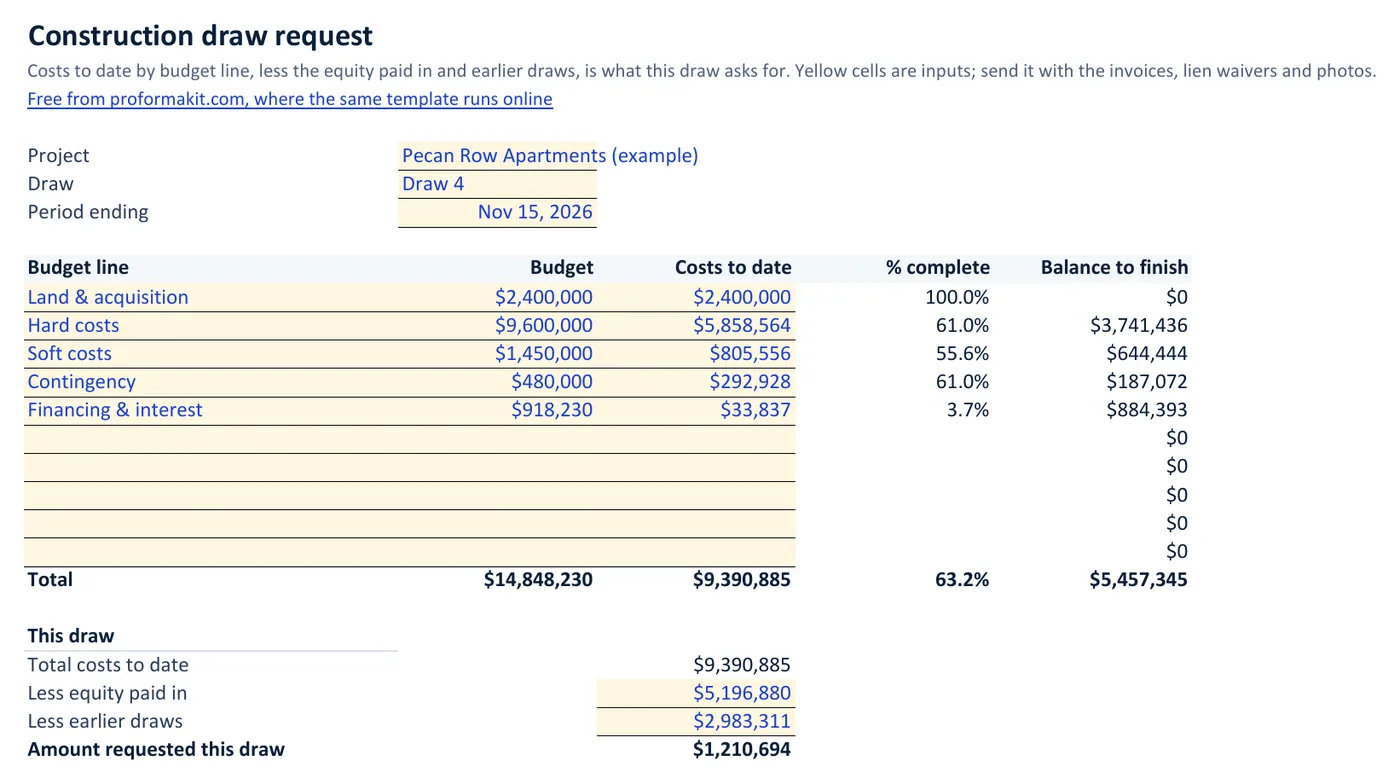
Draw 4, for the period ending November 15, 2026:
| Budget line | Budget | Costs to date | Complete | Balance to finish |
|---|---|---|---|---|
| Land & acquisition | $2,400,000 | $2,400,000 | 100.0% | $0 |
| Hard costs | $9,600,000 | $5,858,564 | 61.0% | $3,741,436 |
| Soft costs | $1,450,000 | $805,556 | 55.6% | $644,444 |
| Contingency | $480,000 | $292,928 | 61.0% | $187,072 |
| Financing & interest | $918,230 | $33,837 | 3.7% | $884,393 |
| Total | $14,848,230 | $9,390,885 | 63.2% | $5,457,345 |
How the amount is worked out
| Total costs to date | $9,390,885 |
| Less equity paid in | -$5,196,880 |
| Less earlier draws | -$2,983,311 |
| Amount requested this draw | $1,210,694 |
|---|
Working from costs to date, rather than adding up this month's invoices, means every request reconciles with the budget and with every draw before it. If an invoice was missed last month, it shows up in costs to date this month and the request picks it up. The earlier draws are only the ones dated before this period, so marking this draw funded later does not change what it asked for.
What goes in the package
Each lender sets its own list. Wisconsin's housing finance agency, WHEDA, publishes its construction draw process, and it is a fair picture of a thorough one:
- A cover letter with the project name and number, a brief explanation of anything unusual in the draw, and who to call with questions. The template's cover sheet has those fields.
- A draw request form for hard costs, certified by the owner, with the contract costs paid to date certified by the general contractor.
- The contractor's payment application on AIA G702 and G703, certified by the project's supervising architect.
- Soft cost invoices, or paid invoices with copies of checks for reimbursement, with costs split into hard and soft and broken down by the line items of the approved budget.
- For materials stored off site, evidence of insurance covering them.
WHEDA also asks developers to make sure the title company and a third-party inspector receive every draw, and the title company releases the money once an endorsement is issued to the title commitment.
What gets a draw approved faster
Lenders and developers disagree on where the time goes. In Rabbet's 2026 State of Construction Finance Report, developers gave a median of 10 days from request to funding and lenders gave 6.5, and asked where a delayed draw package sits, 92% of lenders pointed to the borrower correcting errors or missing documents.
The underwriter's side shows in a BiggerPockets thread on draw underwriting from October 2026: draws are paid "against your approved Scope of Work (SOW)", so each line you request has to match the scope the lender signed off.
If your lender has its own form
Some do. WHEDA requires its own Developer Excel Spreadsheet for every draw, prepared by its staff after closing. Tracking each request from submitted to funded is what draw management software is for. Fill in your lender's form from the same numbers: costs to date by line, equity in, earlier draws. Where the monthly draws come from in the first place is the construction draw schedule, and the budget lines and costs to date come from the construction budget template. The whole cycle, from invoice to funding, is in how construction loan draws work.
Questions
What is a construction draw request?
The developer's request to the construction lender to release part of the loan for work completed. It shows costs to date by budget line, the equity already in and earlier draws, and asks for the difference, with invoices, lien waivers and the contractor's pay application attached.
What does a draw request look like?
A table of every budget line with its budget, costs to date, percent complete and balance to finish, then a short sum: total costs to date, less the equity paid in, less earlier draws, equals this request. The example on this page is laid out exactly that way, and so is the Excel template.
What is the difference between a draw request and a pay application?
A pay application is the general contractor's bill to the owner for work done, usually on the AIA G702 and G703 forms. A draw request is the owner's request to the lender, which includes the pay application along with soft cost invoices and the other documents the lender wants.
What are the AIA G702 and G703?
Standard American Institute of Architects forms for a contractor's payment application. The G702 is the application and certificate for payment, and the G703 is the continuation sheet that lists each line of the schedule of values with work completed to date.
How often do you submit a draw request?
Usually once a month during construction, on a date agreed with the lender. Some smaller and hard money loans release money by construction stage instead.
Is this draw request template free?
Yes. The Excel file downloads without an email address. It has the draw request sheet and a cover sheet with an attachment checklist.
What if my lender requires its own form?
Use theirs and copy the numbers across. The template's totals by budget line, equity and earlier draws are the same figures any lender form asks for.